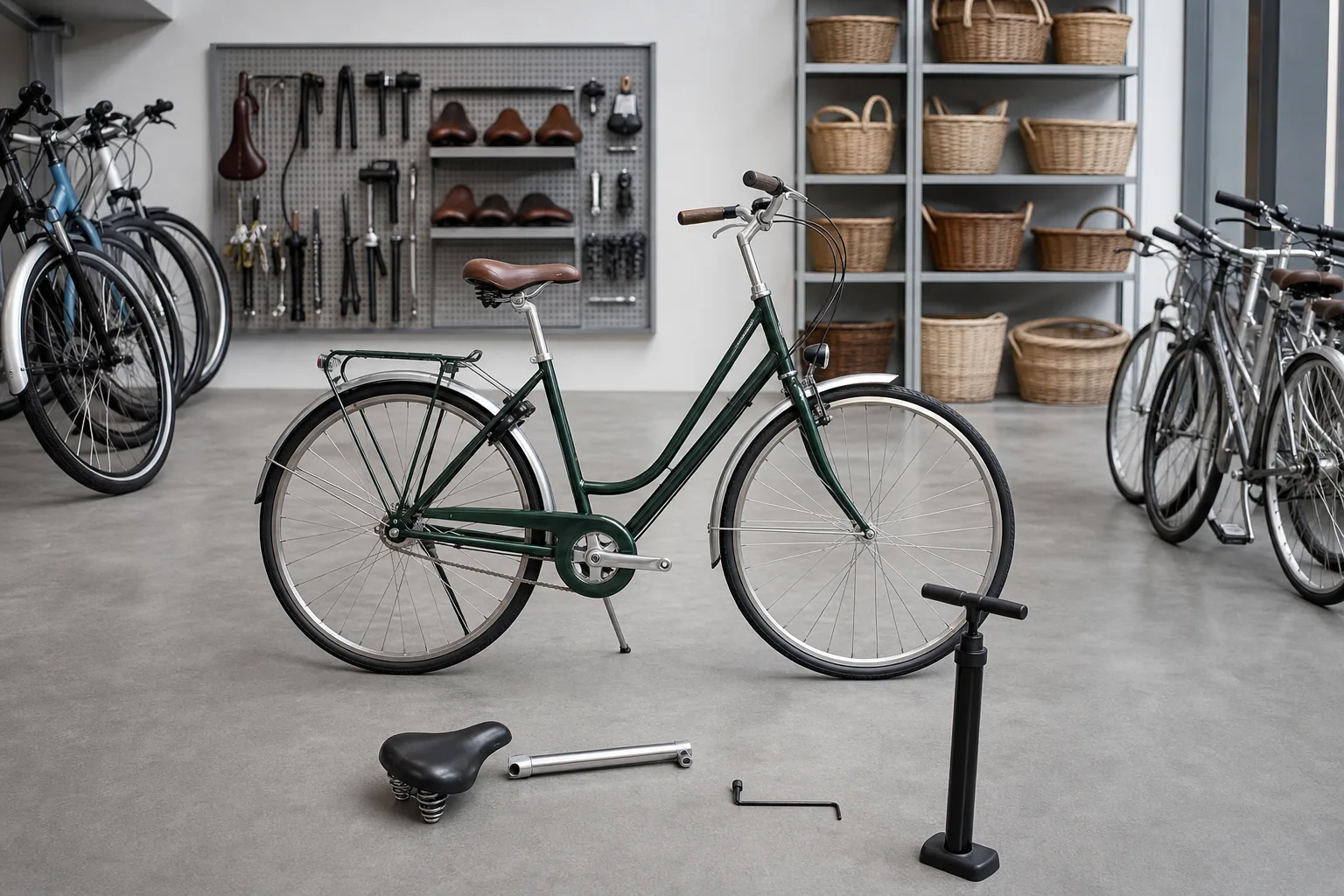
One rider worked through balloon tyres, coaster brakes, saddle height and what a heavy steel frame does on the single hill in town, then wrote down which parts are worth paying for and which ones rust out first.
There are two saddle heights on any upright bike and they are rarely the same number. One is the height that lets you stop, put both feet flat on the pavement, and stay sitting while a truck goes by. The other is the height that lets your leg finish its stroke, so the knee opens most of the way and the big muscles in the thigh do the work instead of the joint. On a step-through comfort frame with balloon tires the gap between them often runs an inch and a half or more, which is enough to turn a pleasant three-mile loop into a dull ache above the kneecap.
What the low seat is actually buying you
The flat-foot position is not vanity or nerves. It is a real answer to a real problem: stopping at a light on a heavy bike, with a basket loaded, on a road crown that tilts you toward the gutter. A rider who can plant both feet without tipping the frame is a rider who is not going to fall at a stop sign, and falls at stop signs account for a good share of the injuries that keep older riders off bikes entirely. The cost is measured at the bottom of the pedal stroke. With the saddle low, the knee never straightens past a deep bend, the quadriceps work through a short cramped range, and pressure loads onto the front of the joint every revolution.
The pedaling height, and what a careful reader checks
The extended position is easier to test than to describe. Sit on the saddle, put your heel on the pedal at the bottom of the stroke, and the leg should be straight or very nearly so; move to the ball of the foot and a slight bend appears, which is the bend you want under load. A careful reader checks two more things before accepting the number. First, whether the hips rock side to side at the bottom, which means the saddle is too high no matter what the heel test said. Second, where the kneecap sits over the pedal spindle when the cranks are level, because a saddle slid too far back changes the angle as much as height does.
Splitting the difference without giving up either one
The usual compromise is to raise the saddle roughly halfway toward the pedaling height and change how you stop. Instead of staying seated and reaching for the ground, you slide forward off the nose of the saddle onto the top tube as you slow, which puts a foot flat with the seat still set high enough to pedal properly. On a step-through there is nothing to straddle, so you simply stand over the frame with one foot down and the other on a raised pedal. Both habits take about a week of deliberate practice at quiet intersections. A shorter crank, if the bike will take one, also shrinks the range the knee has to travel.
How sprung saddles and swept bars move the number
A sprung saddle, the kind with two coil springs under the rear, sags under a rider's weight, and that sag counts against leg extension. Measure the height with your weight on it, not with the bike empty, because the difference can be half an inch on a soft spring. Bar sweep changes the picture from the other end. Bars that curve back toward the rider shorten the reach, which lets you sit more upright, which rolls the pelvis backward and effectively lowers the hip relative to the pedals. Sit up straighter and you often need the saddle a touch higher than the same bike with flatter bars.
Checking it on the road rather than in the driveway
Adjust in small moves, no more than a quarter inch at a time, and ride the same familiar loop after each one. Pain at the front of the knee usually means the saddle is still too low or too far forward; a dull pull behind the knee usually means it went too high. The Consumer Product Safety Commission oversees bicycle safety requirements in the United States, including the minimum insertion mark stamped on the seatpost, and that mark is the hard ceiling. If reaching a comfortable pedaling height would pull the post past it, buy a longer post rather than ignoring the line.
Write the final measurement down, from the center of the bottom bracket to the top of the saddle, and keep it somewhere you will find it after a tune-up or a stolen seatpost.